# Subnetting
Review the IPv4 **Address Classes**
{% content-ref url="ipv4-addressing" %}
[ipv4-addressing](https://ccna-1.gitbook.io/ccna/ipv4-addressing)
{% endcontent-ref %}
IP addresses are assigned companies or organizations by a non-profit American corporation called the IANA, the Internet Assigned Numbers Authority.
* For example, a very large company might receive a class A or class B network, while a small company might receive a class C network
* This led to many wasted IP addresses
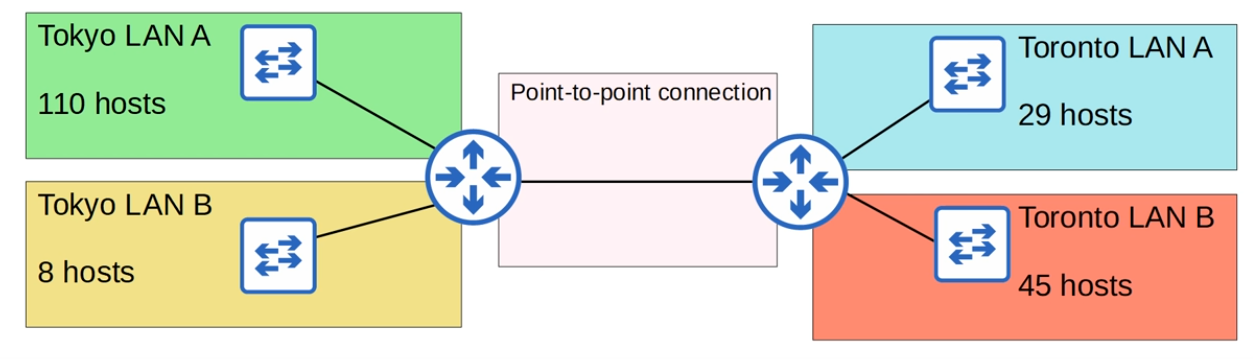
The network between two directly connected routers is called a point-to-point network.
Using the class C, which is the best option for now, we only need 4 addresses to configure the network in the point-to-point network. The class C requires 256 hosts, which is 252 more hosts than needed.
* Obviously, there are many IP addresses wasted.
Another example is: Company X needs IP addressing for 5000 end hosts.
* A class C network does not provide enough addresses, so a class B network must be assigned.
* This will result in about 60000 addresses being wasted.
## CIDR - Classless Inter-Domain Routing
When the internet was first created, the creators did not predict that the Internet would become as large as it is today.
The IETF (Internet Engineering Task Force) introduced CIDR in 1993 to replace the classful addressing system.
With CIDR, the requirements of Class A, B and C were removed.
* This allowed larger networks to be split into smaller networks, allowing greater efficiency.
* These smaller networks are called 'subnetworks' or 'subnets'
## Number of usable addresses per subnet
$$
2^n - 2
$$
* n is the number of host bits
Configuring a point-to-point network requires a /31 mask, which means there are 0 usable addresses, but we do not need the broadcast and network address, which means we can configure the router's interfaces with the 2 IP addresses we can use.
| CIDR Notation | Subnet Mask | Number of Addresses | Usable Hosts |
| ------------- | --------------- | ------------------- | ------------ |
| /32 | 255.255.255.255 | 1 | 0 |
| /31 | 255.255.255.254 | 2 | 2\* |
| /30 | 255.255.255.252 | 4 | 2 |
| /29 | 255.255.255.248 | 8 | 6 |
| /28 | 255.255.255.240 | 16 | 14 |
| /27 | 255.255.255.224 | 32 | 30 |
| /26 | 255.255.255.192 | 64 | 62 |
| /25 | 255.255.255.128 | 128 | 126 |
| /24 | 255.255.255.0 | 256 | 254 |
| /23 | 255.255.254.0 | 512 | 510 |
| /22 | 255.255.252.0 | 1,024 | 1,022 |
| /21 | 255.255.248.0 | 2,048 | 2,046 |
| /20 | 255.255.240.0 | 4,096 | 4,094 |
| /19 | 255.255.224.0 | 8,192 | 8,190 |
| /18 | 255.255.192.0 | 16,384 | 16,382 |
| /17 | 255.255.128.0 | 32,768 | 32,766 |
| /16 | 255.255.0.0 | 65,536 | 65,534 |
| /15 | 255.254.0.0 | 131,072 | 131,070 |
| /14 | 255.252.0.0 | 262,144 | 262,142 |
| /13 | 255.248.0.0 | 524,288 | 524,286 |
| /12 | 255.240.0.0 | 1,048,576 | 1,048,574 |
| /11 | 255.224.0.0 | 2,097,152 | 2,097,150 |
| /10 | 255.192.0.0 | 4,194,304 | 4,194,302 |
| /9 | 255.128.0.0 | 8,388,608 | 8,388,606 |
| /8 | 255.0.0.0 | 16,777,216 | 16,777,214 |
\*️⃣ /31 is an exception and can be used for point-to-point links without reserved addresses for network and broadcast.
## Subnetting based on the number of subnets
$$
2^x
$$
* x = number of **borrowed** bits
* The formula express the number of subnets possible.
e.g
* Subnet the 192.168.255.0/24 network into five subnets of equal size.
* In order to create 5 subnets, we need to borrow 3 bits from the host portion (because 5 <= 2^3)
* The new mask is /24 + the 3 bits we borrowed = /27
* If we have a /27, it means we have 2^5 addresses possible for each subnet
1. 192.168.255.0/27
2. 192.168.255.32/27
3. 192.168.255.64/27
4. 192.168.255.96/27
5. 192.168.255.128/27
## Identify the subnet
* What subnet does host 192.168.5.57/27 belong to?
In order to work out this, you need to make all the host bits 0 or make an AND bitwise operation with the mask.
## Subnets/Hosts (Class C)
| Prefix Length | Number of Subnets | Number of Hosts |
| ------------- | ----------------- | --------------- |
| /25 | 2 | 126 |
| /26 | 4 | 62 |
| /27 | 8 | 30 |
| /28 | 16 | 14 |
| /29 | 32 | 6 |
| /30 | 64 | 2 |
| /31 | 128 | 0 (2) |
| /32 | 256 | 0 (1) |
## Subnets/Hosts (Class B)
| Prefix Length | Number of Subnets | Number of Hosts |
| ------------- | ----------------- | --------------- |
| /17 | 2 | 32766 |
| /18 | 4 | 16382 |
| /19 | 8 | 8190 |
| /20 | 16 | 4094 |
| /21 | 32 | 2044 |
| /22 | 64 | 1022 |
| /23 | 128 | 510 |
| /24 | 256 | 254 |
| /25 | 512 | 126 |
| /26 | 1024 | 62 |
| /27 | 2048 | 30 |
| /28 | 4096 | 14 |
| /29 | 8192 | 6 |
| /30 | 16384 | 2 |
| /31 | 32768 | 0 (2) |
| /32 | 65536 | 0 (1) |
## VLSM
**V**ariable-**L**ength **S**ubnet **M**ask is the process of creating subnets of different sizes, to make your use of network addresses more efficient.
We have to subnet the **192.168.1.0/24** in order to accomodate all the LANs.
### Steps
1. Assign the largest subnet at start of the address space
2. Assign the second-largest subnet after it.
3. Repeat the process until all subnets have been assigned.
We have to sort in descending order the LANs.
1. Tokio LAN A - 110 hosts
2. Toronto LAN B - 45 hosts
3. Toronto LAN A - 29 hosts
4. Tokio LAN B - 8 hosts
5. The point-to point connection - (2 addreses, we can use a /31)
110 + 2 <= 2^7 ⇒ Mask: /32-7 = /25 (255.255.255.128)
* Network: 192.168.1.0/25
* Broadcast: 192.168.1.127/25
* Number of hosts 2^(32 - 25) - 2 = 126
45 + 2<= 2^6 ⇒ Mask: /32 - 6 = /26 (255.255.255.192)
* Network: 192.168.1.128/26
* Broadcast: 192.168.191/26
* Number of hosts: 2^(32- 26) - 2 = 62
29 + 2 <= 2^5 ⇒ Mask: /32 - 5 = /27 (255.255.255.224)
* Network: 192.168.1.192/27
* Broadcast: 192.168.1.223/27
* Number of hosts: 2^(32 - 27) - 2 = 30
8 + 2 <= 2^4 ⇒ Mask: /32 - 4 = /28 (255.255.255.240)
* Network: 192.168.1.224/28
* Broadcast: 192.168.239/28
* Number of hosts: 2^(32-28) - 2 = 14
2 <= 2^1 ⇒ Mask: /32 - 1 = /31 (255.255.255.254)
* First address: 192.168.240.0/31
* Second address: 192.168.241.1/31